
Commercial Renovation Contractor vs Design-Build Firm
Understanding the trade-offs: contractor versus design-build
When owners weigh delivery options for a renovation, the difference between a traditional commercial renovation contractor vs design-build firm can fundamentally alter cost, schedule, and accountability. At Riley Riley Construction, we help owners understand how each approach assigns responsibility, where risk sits, and how that translates into real project outcomes. Choosing the wrong model can add months and unplanned costs; choosing the right one can accelerate delivery and preserve budget.
This guide walks through practical distinctions rather than abstract theory. You'll see how contractual structure affects decision-making, change orders, and contingency management. We'll highlight common scenarios where design-build reduces risk and situations where the conventional contractor-led route may be more economical. If you want to discuss your project specifics, call 17207828897 and we'll help clarify the best path forward.
How delivery methods allocate responsibility
One of the clearest differences between a commercial renovation contractor vs design-build firm is who holds the design and construction risk. In a traditional design-bid-build model, the owner contracts separately with an architect for design and later with a contractor for construction. That separation keeps design control highly independent, but it can create gaps in accountability: when a problem occurs, parties may point back at the contract boundaries rather than resolving it quickly.
In contrast, design-build consolidates design and construction under a single contract. The design-build team becomes the primary point of accountability, responsible for meeting scope, cost, and schedule. That single-source responsibility usually speeds decisions, reduces finger-pointing, and simplifies communication. For owners who prefer a single contract and streamlined dispute resolution, design-build often offers tangible advantages.
Cost comparison: predictable budgets vs competitive bids
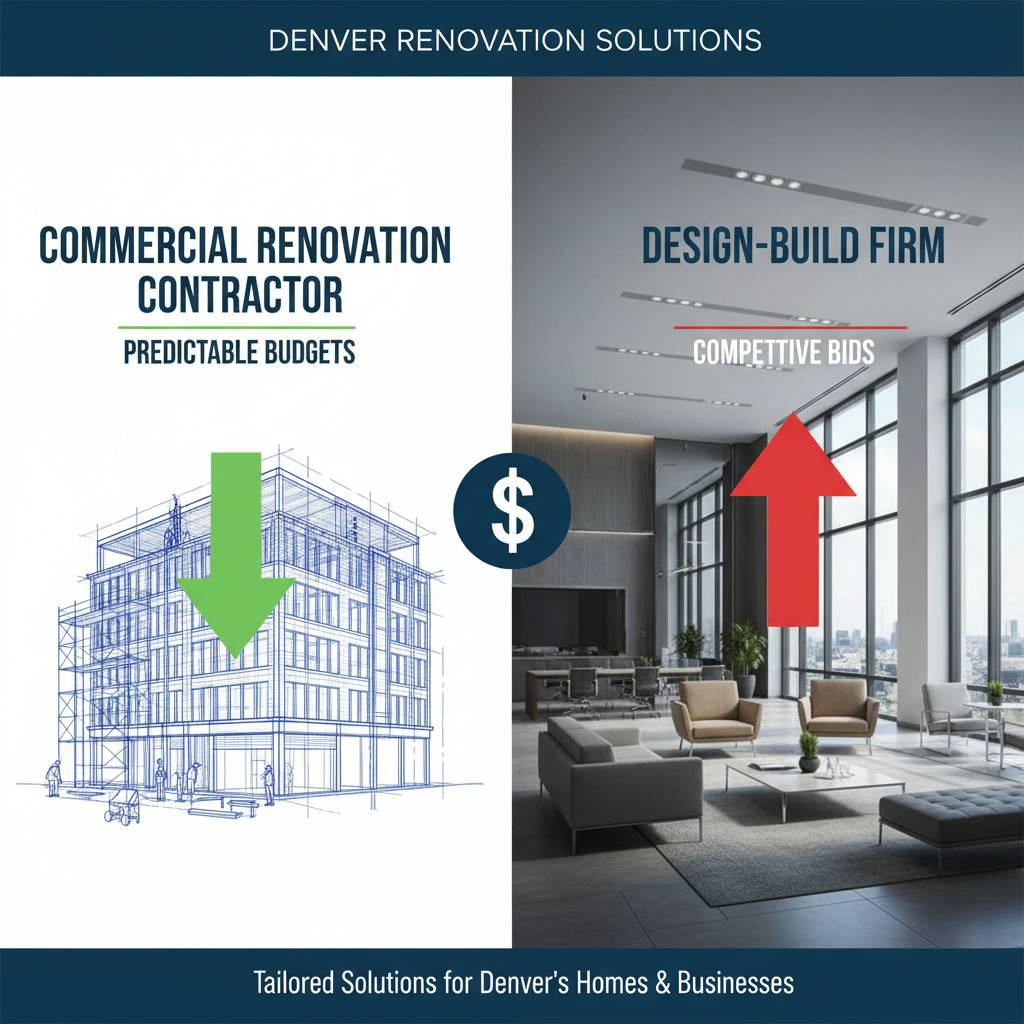 Cost is often the decisive factor. Traditional contracting can deliver lower upfront proposals when plans are fully developed and highly prescriptive, because multiple contractors competitively price the same set of documents. For straightforward renovations with well-defined scope-such as tenant-fit-outs with few unknowns-this model can be economical and provide a tight baseline price.
However, when design is incomplete or site conditions are uncertain, a design-build approach can provide more accurate pricing earlier, because design and construction teams collaborate from the beginning. That collaboration reduces unforeseen scope gaps that often lead to change orders. In many renovation projects, avoiding large change orders yields a lower total cost of ownership even if the initial bid appears higher.
Typical cost ranges and influencing factors
Costs vary widely by market, building type, and finish level, but a few factors consistently influence whether one delivery method saves money:
- Scope clarity: Fully documented scope favors traditional bidding; ambiguous scope favors design-build.
- Site conditions: Unknown conditions (asbestos, concealed structural issues) increase the value of early contractor involvement.
- Schedule pressure: Faster delivery often costs more upfront but reduces overall carrying costs-design-build frequently accelerates schedules.
- Quality and finishes: Highly customized finishes may benefit from contractor input during design to avoid costly rework.
Schedule impacts: speed, overlap, and critical path
Schedule considerations often tip the balance. Design-build enables design and construction phases to overlap, compressing overall delivery time. Early procurement of long-lead items and early mobilization of trades can shave weeks or months from a traditional linear timeline. For projects where time-to-occupancy affects revenue-retail, hospitality, or leased office space-the ability to accelerate completion may justify a premium.
Traditional contracting typically follows a linear path: complete design, bid the work, then build. This sequence can generate very competitive bids when designs are finished, but it also extends the calendar. Owners who are not constrained by time and want to maximize competitive pricing may find the traditional model acceptable and even preferable.
Risk, accountability, and quality control
Risk allocation differs meaningfully between models. With separate contracts, the owner often retains more control over design quality and aesthetics but also takes on increased risk for coordination between design and construction. Mistakes in the design are the owner's responsibility to resolve with the architect and then the contractor, which can lead to higher administrative and legal costs.
Design-build shifts many risks to the design-builder, which results in clearer accountability for defects, schedule slippage, and coordination failures. That shift can be particularly valuable in complex renovations that require specialty trades, phased occupancy, or coordination with building systems. Owners should weigh whether transferring risk justifies potential reductions in direct design control.
Examples of risk scenarios
- Unforeseen structural issues discovered during demolition: design-build teams typically absorb more of the remediation burden, reducing owner exposure.
- Late design changes requested by the owner: traditional models often result in large change orders, whereas design-build may offer integrated cost mitigation strategies.
- Disputes on design intent vs installed work: a single design-build contract minimizes cross-party disputes and simplifies dispute resolution.
When design-build reduces risk-and when it may not
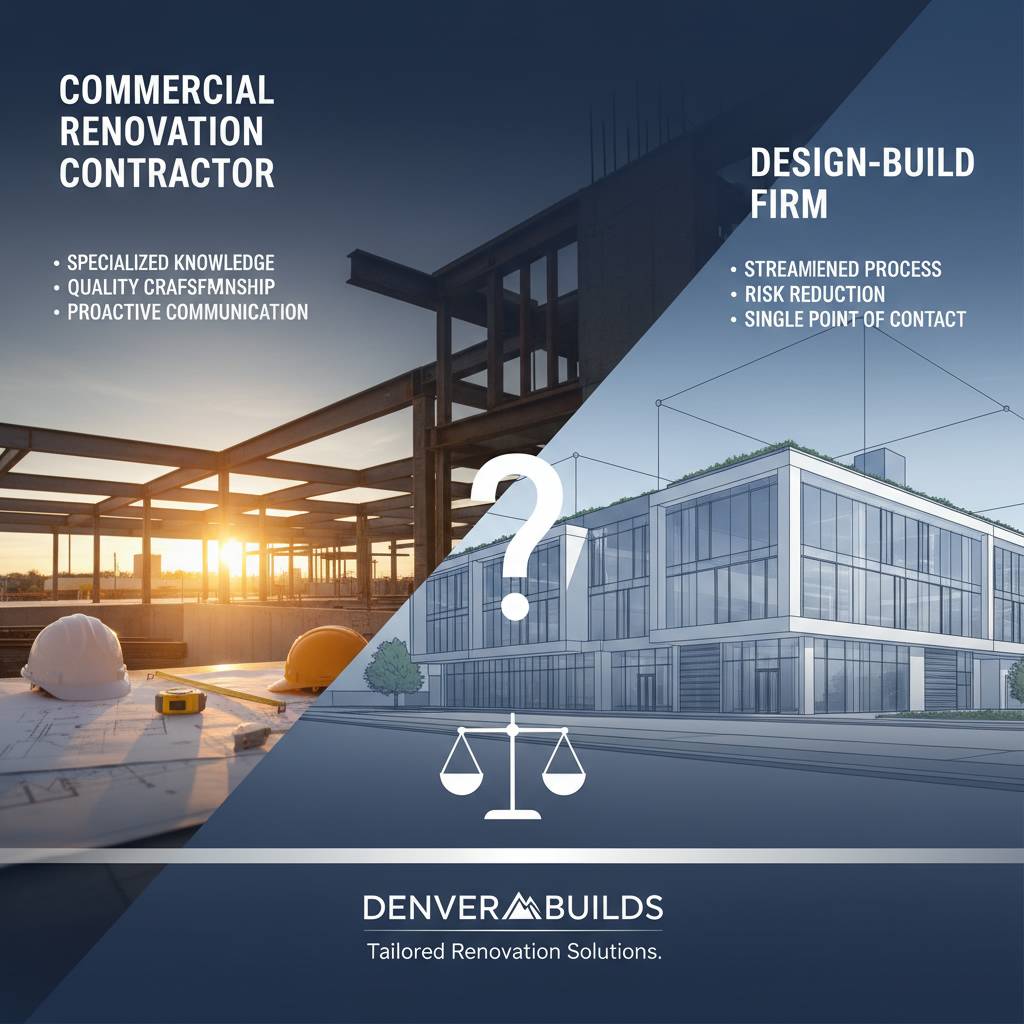 Design-build reduces risk most effectively when a project benefits from early contractor input or when schedule and integration are critical. Examples include phased commercial renovations where tenant spaces are occupied during construction, projects requiring specialty system coordination (HVAC, seismic retrofit), or work with known site complexities like legacy utilities. In these cases, contractor engagement during design identifies constructability issues early and limits costly late-stage changes.
That said, design-build is not a universal solution. Owners with very specific design preferences, requiring strict separation between design and construction for compliance or governance reasons, may prefer traditional contracting. Similarly, when objective competitive pricing is the priority and the scope is fully defined, traditional bidding can produce the most economical outcome.
Decision framework: choose the right model for your objectives
To decide between a commercial renovation contractor vs design-build firm, weigh four core questions: How well-defined is the scope? How important is schedule acceleration? What level of single-point accountability do you need? How tolerant are you of risk and change orders? Mapping your answers to delivery characteristics helps determine the best fit.
Here's a practical checklist to guide the conversation with your project team:
- Is the project scope likely to change during design? If yes, favor design-build.
- Do you have compressed deadlines or revenue tied to occupancy? Consider design-build for faster delivery.
- Do you require the lowest possible initial bid and have a fully developed set of plans? Traditional contracting may be better.
- Is single-source accountability essential for warranty and coordination? Design-build generally provides that.
- Do procurement or funding rules require separation of design and construction? Traditional models may be mandated.
Comparison table: quick view
| Factor | Traditional Contractor (Design-Bid-Build) | Design-Build Firm |
|---|---|---|
| Contract Structure | Separate design and construction contracts | Single contract for design and construction |
| Best Use Cases | Well-defined projects, regulatory separation | Complex, fast-track, high-coordination projects |
| Accountability | Shared; owner manages interfaces | Single-point responsibility |
| Cost Predictability | Competitive bids when design is complete | Improved predictability during design through contractor input |
| Schedule | Linear, potentially longer | Overlap of design/build, typically faster |
Case examples and practical applications
Consider two hypothetical scenarios to illustrate practical differences. First, a retail chain needs a 10,000 sq ft tenant improvement in a new mall with a fixed opening date. The project has aggressive schedule demands and complex MEP coordination. A design-build firm that can lead fast procurement, overlap design with work packages, and manage long-lead items is likely to meet the opening date with fewer costly scope changes.

Second, a landlord wants to upgrade a multi-tenant office building with standardized tenant build-outs, all based on fully developed tenant standards. Because the requirements are prescriptive and repeatable, inviting competitive bids from general contractors using the same set of plans can yield lower prices and simple selection criteria. Here, traditional contracting may be the most economical route.
FAQs: common owner questions answered
Is design-build always more expensive?
Not necessarily. While initial proposals from design-build teams can appear higher, total project cost-including change orders, schedule impacts, and owner oversight-can be lower with design-build. The value lies in risk transfer, coordination efficiencies, and fewer surprises during construction.
Can I combine the two approaches?
Yes. Some owners use a hybrid approach: design-bid for base scope and design-build for specialty or uncertain portions. Another option is to procure a design-only contract followed by a negotiated design-build transition with the preferred contractor, preserving some competitive tension while gaining early contractor input.
How important is contractor selection?
Extremely. Whether you choose a commercial renovation contractor vs design-build firm, experience with similar projects, references, and clear contractual responsibility are critical. Vet teams for track record on budget control, quality, and schedule performance.
How Riley Riley Construction helps owners choose wisely
At Riley Riley Construction, we evaluate your project objectives, risk tolerance, and constraints to recommend the best delivery model. We don't push a one-size-fits-all solution. Instead, we explain how each approach influences cost, schedule, and accountability so you can make a well-informed decision that aligns with your business goals. You might also hear us say in a planning session-that shorthand helps our teams align quickly on owner priorities.
Our process typically includes a brief assessment of scope certainty, schedule sensitivity, and site complexity; a review of procurement or funding rules; and a recommendation that includes projected cost and schedule ranges. For many commercial renovations we see cost envelopes in the range of $75-$200 per square foot depending on complexity and finishes, but every project is different and deserves a tailored analysis.
Next steps and contact information
 If you're evaluating delivery methods for an upcoming renovation, start with a short feasibility discussion. We can help you map risks, estimate ranges, and determine whether the reduced change-order exposure of design-build or the competitive pricing of traditional contracting better serves your objectives.
To schedule a consultation or ask specific questions about your project, contact Riley Riley Construction at 17207828897. Our team will listen to your priorities and provide pragmatic, owner-focused advice designed to maximize your ROI.
Quick call-to-action: Ready to compare options? Call 17207828897 to arrange a no-obligation review of your scope and an action plan that fits your timeline and budget.
Thank you for considering Riley Riley Construction as your partner in making the right delivery decision for your renovation. We look forward to helping you choose the model that best protects your budget, accelerates schedule, and delivers accountable results. Contact Riley Riley Construction at 17207828897 to get started.