
Energy-Efficient Upgrades That Cut Operating Costs
Energy-efficient upgrades that cut operating costs: an overview
Facilities today face persistent pressure to reduce operating expenses while maintaining occupant comfort and productivity. Riley Riley Construction specializes in identifying the highest-impact energy-efficient upgrades that cut operating costs and improve net operating income. Our approach quantifies savings from lighting, HVAC, and building envelope improvements so owners and managers can see a clear, data-driven return on investment before committing capital.
Energy upgrades are not one-size-fits-all. The right combination of measures depends on building type, climate, occupancy patterns, and equipment condition. We begin with a careful assessment to prioritize measures by payback period and lifetime value, balancing upfront cost against long-term operating savings and resilience. If you want a focused energy upgrade assessment and estimated payback period, reach out at 17207828897.
Why energy-efficient upgrades matter for operating costs and NOI
Reducing energy consumption directly lowers utility bills, but the value of upgrades goes beyond monthly savings. Lower energy use reduces maintenance needs, extends equipment life, and can improve asset valuation through higher net operating income (NOI). For commercial property owners, even a few percentage points of energy savings can translate to meaningful improvements in capitalization rates and property value.
Investments in efficiency also mitigate exposure to volatile energy prices and create a measurable resilience advantage. In many markets, tenants and buyers increasingly favor buildings with lower operating expenses and robust sustainability profiles, which can improve occupancy and allow owners to command higher rents. That makes energy-efficient upgrades a strategic capital decision as much as an operational one.
Highest-impact measures: lighting, HVAC, and envelope
 Three categories typically deliver the largest, most reliable savings: lighting systems, HVAC equipment and controls, and the building envelope. Each area offers a mix of low-cost, quick-payback measures and deeper capital projects with longer-term returns. Our team evaluates each category for savings potential, cost, and ease of integration with existing systems.
Lighting upgrades
Modern lighting retrofits are often the fastest way to reduce consumption with clear paybacks. Replacing legacy fluorescent or incandescent fixtures with high-efficiency LED luminaires can yield 40%-70% energy savings in lighting loads alone. When combined with controls-occupancy sensors, daylight harvesting, and scheduling-total lighting energy reductions can be even greater while delivering improved visual comfort for occupants.
Typical costs and considerations vary by project size and fixture type, but common estimates include fixture upgrades at $75-$200 per fixture for commercial installations, and additional savings from intelligent controls. For many buildings, simple LED retrofits pay back in 2-4 years, while adding advanced controls shortens payback further.
HVAC and controls
HVAC is often the largest single energy expense in commercial buildings. Replacing aging chillers, boilers, and rooftop units with high-efficiency models produces significant savings, but the most cost-effective gains frequently come from improved controls and system tuning. Upgrading to variable-speed drives, modern building automation systems (BAS), and setpoint optimization can reduce energy use substantially without full equipment replacement.
Controls upgrades also improve occupant comfort and reduce maintenance costs by enabling predictive diagnostics and tighter system staging. In many cases, a controls-first strategy reduces capital need while capturing immediate operational savings, creating room in the budget for future equipment renewals.
Building envelope improvements
Envelope measures-insulation, air sealing, window upgrades, and reflective roofing-reduce heating and cooling loads and stabilize interior conditions. These improvements tend to be more site-specific but yield consistent benefits: lower energy use, reduced HVAC runtimes, and improved occupant comfort. For older properties with drafty envelopes, air-sealing alone can produce meaningful energy reductions and faster paybacks than you might expect.
Envelope investments also enhance long-term durability and can reduce moisture risk when executed properly. Combining envelope upgrades with HVAC right-sizing can generate a virtuous cycle of smaller, more efficient mechanical systems and lower first costs for future replacements.
Quantifying savings and demonstrating ROI
Decision-makers need credible numbers. Riley Riley Construction produces energy models and measured baseline studies to estimate savings with confidence. We use utility data analysis, on-site metering, and software-calibrated models to quantify annual energy reductions, peak demand impacts, and dollar savings. This rigorous approach yields an estimated payback period, simple ROI calculations, and lifecycle cost comparisons for competing measures.
Our typical output includes annual kWh and therm savings, expected annual dollar savings, measure cost, simple payback (years), and internal rate of return where appropriate. For example, an LED lighting retrofit that saves 100,000 kWh annually at $0.12/kWh yields $12,000 in annual savings; if the retrofit costs $30,000, the simple payback is 2.5 years. We present results visually and numerically so stakeholders can weigh options quickly.
Example comparison table
| Measure | Estimated Cost | Typical Annual Savings | Simple Payback |
|---|---|---|---|
| LED lighting controls | $30,000 | $12,000 | 2.5 years |
| BAS and controls upgrade | $50,000 | $18,000 | 2.8 years |
| RTU replacement with ECM fans | $75,000 | $20,000 | 3.8 years |
| Insulation and air-sealing | $25,000 | $8,000 | 3.1 years |
Tables like this one are illustrative and based on typical projects; actual values depend on local energy prices, run hours, and building specifics. We tailor our calculations for each client so the expected effect on net operating income is transparent and verifiable.
Assessment and implementation process
A clear, phased approach reduces risk and accelerates savings. Our assessment process starts with document review and utility bill analysis, followed by a targeted site visit to inventory systems and identify quick wins. From there we develop a prioritized action plan with estimated costs, projected savings, and payback periods. Stakeholders receive a concise executive summary and a technical appendix for deeper review.
Implementation follows a staged plan that often begins with low-cost, high-impact measures-LED upgrades, sensor tuning, and controls optimization-then progresses to capital projects like equipment replacement and envelope work. We can manage the full implementation, coordinate subcontractors, and verify savings through post-installation measurement and verification (M&V). That verification converts predicted savings into documented, bankable results.
Typical project timeline
- Week 1-2: Data collection and utility analysis
- Week 3-4: Site assessment and preliminary savings modeling
- Week 5-6: Final report with prioritized measures and budgets
- Month 2-6: Implementation of short-term measures and controls
- Month 6-18: Capital projects and verification
Timelines vary by project scope and procurement processes, but staging work this way delivers faster cost relief while keeping long-term investments aligned with the facility's capital planning cycle.
Financing, incentives, and risk mitigation
 To make upgrades accessible, we evaluate financing options and identify available incentives. Many measures qualify for utility rebates, tax incentives, or performance-based financing that preserves capital. Accessing third-party capital, such as energy service agreements or lease structures for equipment, can allow projects to be cash-flow neutral from day one by using savings to cover payments.
Incentive programs frequently change, so Riley Riley Construction stays current on local and federal offerings to maximize upfront rebates and reduce payback periods. We also use conservative assumptions for baseline energy use to avoid overstating benefits and incorporate contingency allowances in project budgets to mitigate implementation and operational risks.
Case study: measurable NOI improvement
A 150,000 square-foot office building in a temperate climate engaged Riley Riley Construction to identify measures that would improve NOI. The facility had older fluorescent fixtures, manual HVAC scheduling, and moderate envelope leakage. Our baseline analysis found annual energy spend of $240,000 with an energy use intensity of 70 kBtu/sf-year, leaving room for improvement compared to peer buildings.
We recommended a phased program: LED lighting and controls, a BAS upgrade with optimized schedules, and targeted air-sealing plus attic insulation. Implementation cost was $165,000 after utility incentives. The combined estimated annual savings were $66,000, producing a simple payback of 2.5 years. After year one of verified savings, owner-operational cash flow improved and the asset achieved a documented reduction in operating expenses that translated into an increase in the property's net operating income and a stronger valuation.
Frequently asked questions
Owners and managers often ask similar questions about risk, cost, and verification. Below are concise responses to the most common concerns.
How soon will I see savings?
Many upgrades, such as LED retrofits and controls changes, begin reducing energy consumption immediately upon installation. Larger capital projects require commissioning and system tuning to realize full savings, but most clients see measurable reductions within the first billing cycle after implementation.
How accurate are payback estimates?
Estimates are based on measured utility data, on-site observations, and calibrated energy models. We present conservative scenarios alongside best-case projections and include sensitivity analysis for energy price changes and operating hours to help stakeholders understand the range of possible outcomes.
Do upgrades disrupt building operations?
We plan projects to minimize occupant disruption. Many measures, such as lighting and controls upgrades, can be completed during off-hours. For larger replacements, we coordinate phased work and temporary measures so tenant comfort and safety are maintained throughout the project.
Next steps and engagement options
If you're evaluating energy-efficient upgrades that cut operating costs, a structured assessment is the best next step. Riley Riley Construction offers a tiered engagement model: a focused walk-through and savings estimate, a comprehensive energy audit with modeling, or a full design-build and verification service. Each option is designed to give predictable outcomes and clear financial metrics for decision-makers.
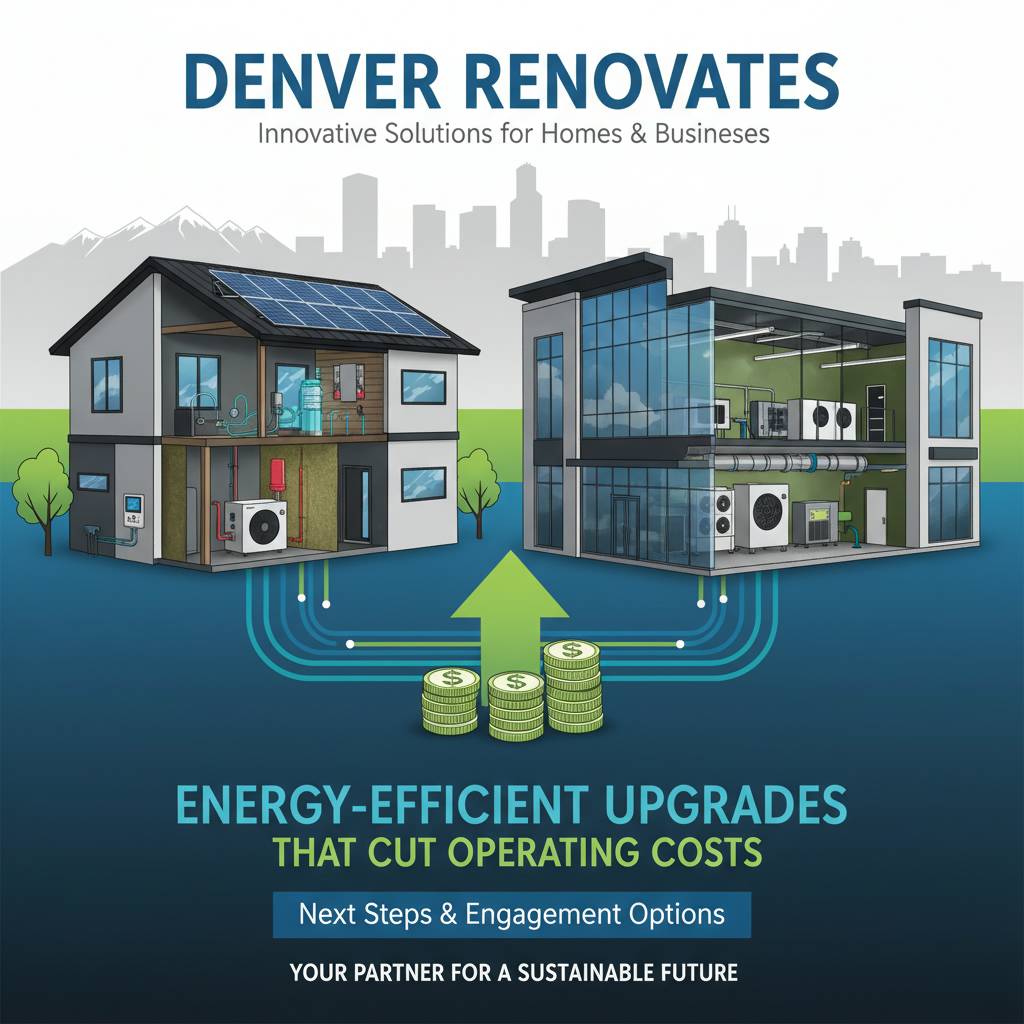
Our assessments include an action plan prioritizing measures by payback and impact, estimated budgets, potential incentives, and a proposed implementation schedule. Where helpful, we provide projected NOI improvement and valuation impact so owners can align energy investments with broader financial goals. You may also request a pilot scope to validate results before scaling the program across a portfolio.
Ready to quantify savings and improve NOI? Contact Riley Riley Construction for an energy upgrade assessment and estimated payback period at 17207828897. One of our specialists will outline practical next steps tailored to your building and financial objectives.
For a quick consultation or to schedule an on-site assessment, reach out today. Riley Riley Construction looks forward to helping you balance upfront cost with long-term operating savings and delivering measurable improvements to your property's bottom line. Call 17207828897 to get started.