Financing Options for Commercial Renovations and ROI
Financing can unlock renovation projects that significantly increase property value, and Riley Riley Construction helps owners compare loan and lease options. We explain how different financing structures affect cash flow and long-term ROI so you can choose the best path. Call 17207828897 to discuss financing scenarios tailored to your renovation goals. Our team connects you with lenders and packages that optimize returns and preserve working capital.
Why financing matters for commercial renovation and value creation
Renovations frequently present the clearest opportunity to increase a property's market value, tenant demand, and net operating income. Yet many owners hesitate because of the upfront capital required or uncertainty about payback timelines. Thoughtful financing lets you undertake higher-impact projects-such as lobby modernization, energy-efficiency upgrades, or reconfiguring floor plates-without exhausting cash reserves that could be used for operations or additional investments.
Understanding financing options for commercial renovations is not just about securing money; it's about structuring repayment and risk in a way that enhances long-term ROI. The right financing can smooth cash flow, align debt service with expected revenue gains, and in many cases improve tax treatment or provide access to incentives. Conversely, the wrong structure can erode margin and reduce the overall return you expect from the renovation.
Common financing structures and how they differ
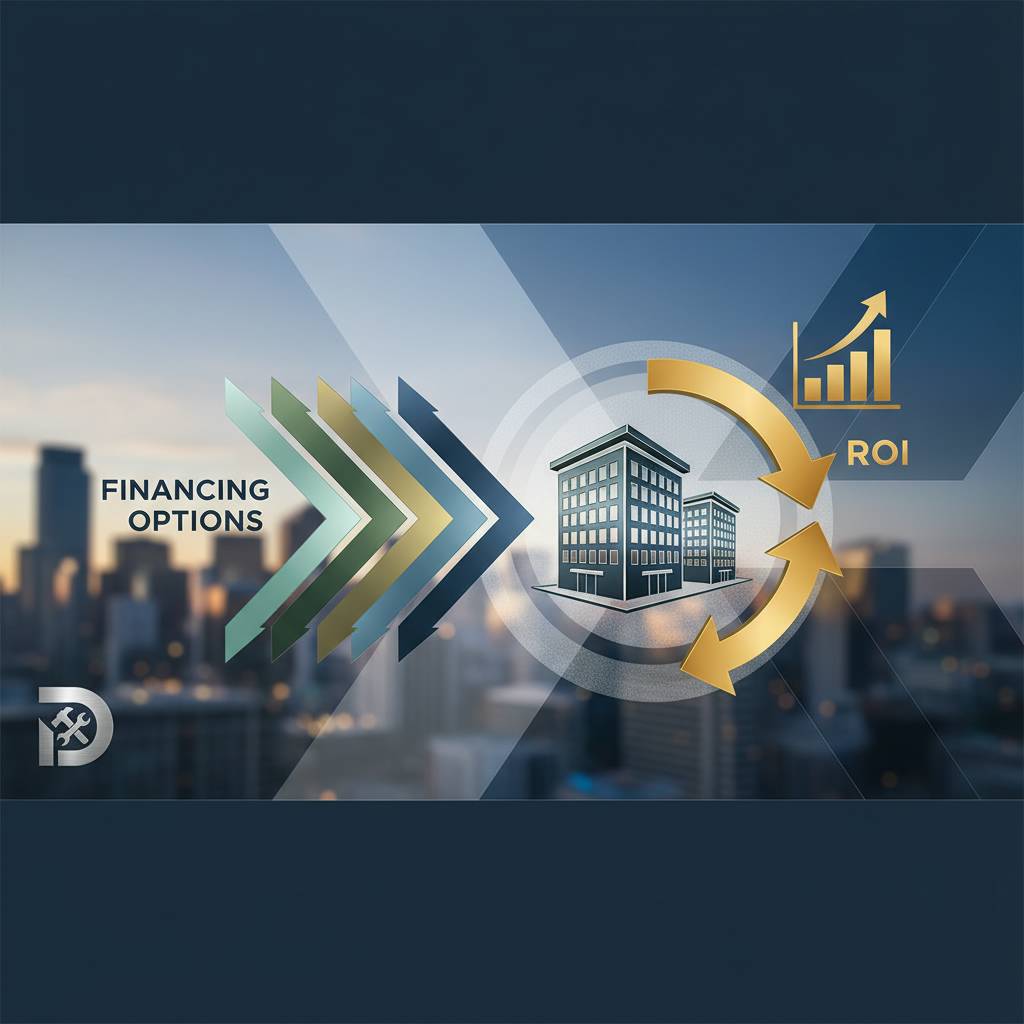 Commercial renovation financing comes in several flavors, each with trade-offs for cost, term, and flexibility. Traditional bank loans, construction loans, equipment leases, property-assessed clean energy (PACE) loans, mezzanine financing, and even tax-credit-backed instruments are all commonly used. Choosing among them requires weighing interest rates, collateral requirements, amortization schedules, and how each impacts your balance sheet and cash flow.
Bank loans and construction loans
Bank term loans and construction loans are familiar choices: they typically offer competitive interest rates but often require strong credit, collateral, and a detailed project plan. Construction loans may be interest-only during the build phase and convert to a longer-term mortgage when stabilization occurs. This approach is attractive when you want predictable, long-term financing and you can meet lender documentation requirements.
Equipment leases and energy financing
Equipment leases and finance leases are ideal for systems like HVAC, elevators, or lighting where the asset itself has value and measurable energy savings. A lease can preserve working capital because it spreads payments over the asset's useful life. Products such as PACE financing or energy service agreements can also shift costs off the immediate balance sheet while capturing energy-based savings that improve net operating income and ROI.
Mezzanine financing and preferred equity
When you need additional capital but prefer not to dilute ownership or increase senior debt, mezzanine loans or preferred equity can fill the gap. These options often carry higher interest rates or require equity-like returns to investors, but they provide flexibility and can be structured with payment-in-kind features. They are useful for larger repositioning projects where timing and certainty of cashflow improvements justify a higher overall cost of capital.
How financing choices affect cash flow and ROI
Every financing structure influences monthly or annual cash requirements and the timing of returns. Short-term, high-rate financing increases recurring costs and compresses near-term cash flow, which can be risky if tenant lease-up or rent increases take longer than expected. Conversely, longer-term amortization lowers immediate payments but increases total interest paid. A careful analysis models both scenarios to determine which maintains positive cash flow while maximizing net present value.
ROI analysis should include more than construction cost vs. post-renovation appraisal. Account for financing fees, closing costs, interest expense, tax treatment of interest and depreciation, and any incentive or rebate programs that reduce net project cost. A commonly used metric is leverage-adjusted internal rate of return (IRR), which shows the impact of different financing mixes on the investor's return after debt service and fees.
Cash-on-cash and break-even considerations
Cash-on-cash return measures the annual before-tax cash flow relative to cash invested and is especially useful for owners focused on operating income. Break-even analysis calculates the occupancy or rent level needed to cover debt service and operating costs after renovation. Combining both metrics helps you select a financing option that satisfies short-term coverage ratios while maximizing long-term ROI.
Practical comparison: loan vs. lease vs. PACE
Choosing between a loan, a lease, or PACE financing often comes down to three questions: How quickly will the renovation generate additional income? How important is preserving capital? And how will the financing appear on your balance sheet? Below is a concise comparison to help clarify trade-offs.
| Structure | Typical Term | Balance Sheet Impact | Best Uses |
|---|---|---|---|
| Bank Term Loan | 5-25 years | Liability (mortgage or loan) | Major renovations with predictable cashflow |
| Equipment Lease | 3-10 years | May be off-balance-sheet depending on accounting | HVAC, lighting, and tenant systems |
| PACE / Energy Financing | 10-30 years | Assessed on property taxes; long-term obligation | Energy efficiency and renewable projects |
| Mezzanine / Preferred Equity | 3-10 years | Subordinate debt or equity-like | Gap financing for value-add repositioning |
Example cost scenarios
Consider a $1,000,000 renovation that increases net operating income by $120,000 annually. If financed with a 10-year bank loan at 5% versus a 20-year PACE loan at 6.5%, the short-term debt service will be higher under the 10-year loan but total interest paid may be lower. If the NOI improvement is immediate and stable, a shorter term can accelerate equity build-up. If improvements are gradual or you value cash-on-cash, the longer PACE term may improve liquidity while you capture energy savings.
How to evaluate financing offers strategically
 Compare offers on these core factors: effective interest rate (including fees), amortization schedule, prepayment terms, covenants, and any landlord or tenant obligations tied to the project. It is also critical to understand lender timelines and draw processes; delays in funding or restrictive draw schedules can stall construction and inflate costs. Simulate worst-case scenarios-slower lease-up, construction delays, or modest rent growth-so you choose a structure that remains viable under stress.
Request a side-by-side cash flow model from lenders that shows monthly debt service, interest vs. principal split, and cumulative cash deployment over the project timeline. Ask for sensitivity analyses showing results if rents increase by only 50% of projected amounts or if vacancy rates stay higher than anticipated. A disciplined approach to underwriting protects ROI and prevents over-leveraging the property.
- Insist on full disclosure of all fees and prepayment penalties.
- Confirm whether financing triggers tenant consent requirements or affects existing lease covenants.
- Verify tax implications-interest deductibility and accelerated depreciation can materially affect net returns.
Case studies: outcomes from different financing paths
Case 1: A mid-size office owner chose a fixed-rate bank loan to finance a lobby and common-area upgrade. Because the project targeted immediate tenant retention and modest rent bumps, the owner benefited from a predictable debt service that matched improved NOI. The project paid back in under five years and increased property value by 12% at the next appraisal.
Case 2: A retail center owner used an equipment lease for LED lighting and a PACE loan for solar installation. Upfront costs were minimal, tenant disruption was low, and energy savings improved operating margins. The longer-term PACE structure preserved capital for tenant improvements and enabled more aggressive leasing incentives, yielding stronger occupancy and a higher stabilized NOI.
Case 3: A value-add multifamily investor bridged a large renovation with mezzanine debt to avoid diluting returns. Although the mezzanine carried higher interest, its flexible payment terms allowed the owner to complete a gut renovation, reposition units, and increase rents substantially. Once stabilized, the property was refinanced into a lower-cost mortgage, generating a high IRR for equity investors.
How Riley Riley Construction helps you compare options and optimize ROI
Riley Riley Construction specializes in matching owners with financing that complements renovation goals and risk tolerance. Our advisors begin by modeling expected cash flows, running sensitivity analyses, and aligning financing structures with operational objectives-whether that means maximizing short-term cash-on-cash returns or preserving capital for further acquisitions. We also maintain relationships with banks, specialty lenders, and lease vendors to surface competitive terms quickly.
When you work with Riley Riley Construction, we can coordinate underwriting, negotiate covenants, and present lender-ready packages that reduce friction and shorten time to close. If you have a preferred structure in mind, we'll benchmark it against alternatives to show the long-term ROI implications plainly. Where regulatory or incentive programs apply, we'll help integrate those savings into the financing strategy.
What to expect in a consultation
In an initial consultation, expect a focused review of your project scope, budget, rent-up assumptions, and desired timeline. We'll ask about current debt, balance sheet preferences, and appetite for covenant flexibility. Within days, we produce comparable financing scenarios that illustrate monthly debt service, amortization, and projected ROI under conservative, base, and optimistic cases.
Frequently asked questions
Will financing increase my property value?
Well-structured financing enables renovations that raise net operating income, which in turn increases market value. However, the extent of value uplift depends on the renovation's quality, market demand, and how financing costs affect cash flow. Financing alone does not create value-it's the investment in the property combined with supportive market conditions and effective execution.
How do I measure whether a financing option improves ROI?
Compare leverage-adjusted IRR and cash-on-cash returns across options, including fees and interest. Run a 3- to 10-year horizon analysis that includes refinancing or sale scenarios. Factor in tax impacts and any non-cash financing elements. If the financing improves net present value after debt service and fees under conservative assumptions, it's likely to enhance ROI.
Is it better to refinance after renovations are complete?
Refinancing post-renovation is common when initial construction financing is short-term. If your renovation achieves the projected NOI improvements, refinancing can lower your cost of capital and lock in longer-term stability. Timing depends on market rates and lender requirements; build refinancing scenarios into your financial model before selecting construction financing.
Next steps and how to get started
Start with a clear scope and budget: define the renovation objectives, desired tenant or operational outcomes, and a timeline. Assemble existing financial statements, current debt schedules, and lease rolls-these documents speed up lender conversations. Then contact Riley Riley Construction for a structured review; we'll prepare financing comparisons and recommend paths that align with your ROI goals.
To discuss customized financing scenarios or to receive a preliminary modeling package, call 17207828897 or request a consultation. Our team will walk you through practical options, highlight trade-offs, and help select a plan that preserves working capital while maximizing long-term returns.
Take action: If you have a renovation concept in mind, bring us basic budget estimates and projected rent or savings. We'll show how different financing options affect monthly cash flow, break-even performance, and ultimate ROI so you can make an informed decision.
Contact Riley Riley Construction at 17207828897 to explore financing options for commercial renovations and ROI-driven strategies. We look forward to helping you choose the best financing path for your renovation goals.