
Measuring ROI After a Commercial Renovation
Introduction: The importance of quantifying post-renovation ROI
Renovations are more than aesthetic upgrades; they are investments that should deliver measurable returns. When owners and investors commit capital to upgrade commercial properties, understanding the financial impact is critical. Riley Riley Construction provides a repeatable approach to measuring revenue, occupancy, and operating cost changes so stakeholders can validate whether the renovation met its objectives and supported long-term value creation.
Measuring ROI after a commercial renovation requires thoughtful planning before construction begins, consistent data collection during the transition, and disciplined analysis after re-opening. A structured methodology reduces ambiguity, helps prioritize future capital allocation, and creates confidence among lenders, partners, and investors. This page outlines practical steps for establishing baselines, tracking improvements, and reporting results in a way that is transparent and defensible.
Why establish baseline metrics before construction?
Creating a clear pre-construction baseline is essential because it defines the reference point from which all performance changes are measured. Without an accurate baseline, it is difficult to separate renovation effects from market trends, seasonality, or operational changes. A baseline captures both financial and operational indicators-revenue streams, occupancy or utilization rates, customer or tenant turnover, and operating expenses-that collectively shape net operating income and capital return calculations.
Establishing a baseline also enables stronger causal inference. By recording current conditions in detail, you can later attribute improvements to specific renovation elements. For example, a lobby redesign that improves tenant retention will show up in occupancy and turnover metrics; better energy systems will appear in lower utility consumption. Baselines support both short-term evaluation and long-term benchmarking across multiple assets in a portfolio.
Core metrics to measure: revenue, occupancy, and operating costs
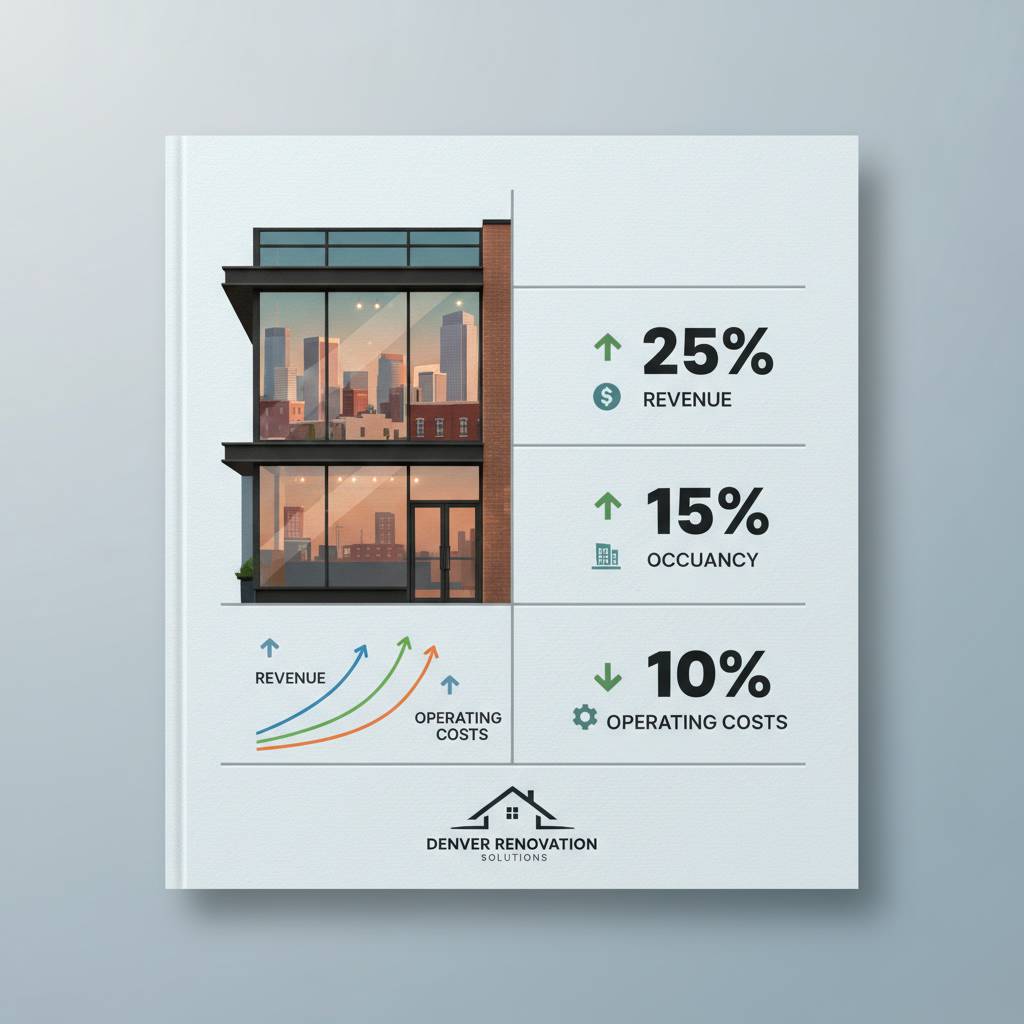 When measuring ROI after a commercial renovation, focus on metrics that directly affect cash flow and asset value. Primary indicators include gross revenue, net operating income (NOI), occupancy or utilization rates, average revenue per unit or tenant, and specific operating cost line items such as energy, maintenance, and staffing. Tracking these measures consistently allows for straightforward before-and-after comparisons and more sophisticated statistical adjustments when needed.
Secondary metrics provide context and help explain the why behind the numbers. Customer or tenant satisfaction scores, lease renewal rates, foot traffic, and average transaction sizes are valuable leading indicators that often precede sustained changes in revenue and occupancy. Together, primary and secondary metrics form a comprehensive dashboard that makes renovation outcomes interpretable and actionable.
- Revenue metrics: gross revenue, ancillary income, average revenue per unit
- Occupancy/utilization: occupancy rate, turnover, lease renewals
- Operating costs: utilities, maintenance, staffing, management fees
- Performance indicators: NOI, cash-on-cash return, payback period
Designing a repeatable ROI measurement plan
A repeatable measurement plan begins with a clear scope and timeline. Define the specific renovation elements you want to evaluate, the reporting intervals (monthly, quarterly), and the comparison windows (12 months before vs. 12 months after, for example). Decide which data sources you will use-property management systems, utility bills, point-of-sale systems, and tenant or customer surveys-and assign responsibilities for consistent data entry and quality control.
Standardization is the key to repeatability. Use consistent units (dollars, percentage points, kWh, visits), establish definitions for metrics (what counts as occupancy, what constitutes ancillary revenue), and maintain a central data repository. Riley Riley Construction recommends documenting the methodology in a short measurement plan so stakeholders understand how metrics were derived and can reproduce the approach across other assets.
Include a plan for normalizing external influences such as seasonal demand shifts, local market trends, or one-time expenditures. Adjustments might involve year-over-year comparisons, regression analysis to control for market variables, or the use of matched control properties when available. These techniques sharpen the signal of renovation impact and reduce the risk of over- or under-crediting changes to the construction work.
Data collection and analysis methods
Collecting high-quality data begins well before the first demolition permit is issued. Gather at least 12 months of historical data when possible to capture seasonal variability. Key sources typically include financial statements, utility bills, occupancy records, reservation or lease databases, and operational logs. Digitize and centralize this information to enable automated reporting and reduce transcription errors.
Once data is collected, perform a stepwise analysis. First, validate and clean the datasets-look for missing periods, anomalous spikes, or accounting irregularities. Next, compute core KPI trends and visualize them with simple charts. Compare pre- and post-renovation periods using both absolute and percentage changes. For robust conclusions, consider statistical methods such as difference-in-differences or time series analysis to isolate the renovation effect from broader market movements.
| Metric | Pre-renovation baseline | Post-renovation target | How to measure |
|---|---|---|---|
| Gross revenue | $X,XXX | $X,XXX Y% | Accounting records; monthly aggregation |
| Occupancy rate | 75% | 85% | Lease/booking data; average daily occupancy |
| Operating costs | $X,XXX | Reduce by Z% | Utility bills, maintenance invoices |
In many cases, small sample sizes or short post-renovation windows complicate analysis. When faced with limited data, supplement quantitative analysis with qualitative insights from tenant feedback, staff observations, and targeted surveys. These inputs can explain early performance patterns and guide adjustments to operating strategies that accelerate the achievement of financial goals.
Translating performance into ROI and value metrics
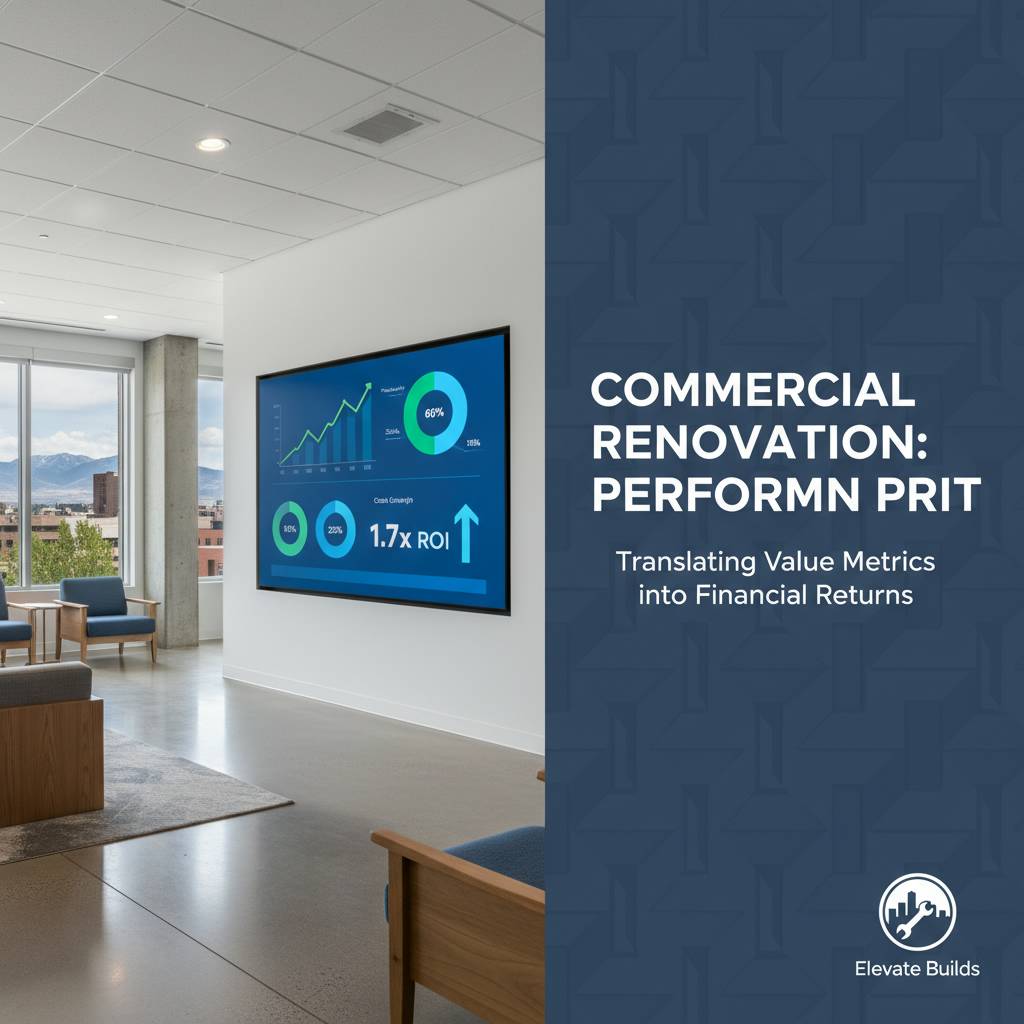 Calculating ROI after a commercial renovation typically involves comparing incremental cash flows to the initial capital expenditure. Start by estimating the change in NOI attributable to the renovation-additional revenue minus avoided or reduced operating costs. Divide the incremental annual NOI by the renovation cost to estimate a cash-on-cash return or simple payback. For a more complete valuation, incorporate discounting to compute net present value (NPV) or internal rate of return (IRR).
Translating operational improvements into property value can be done using capitalization approaches. If NOI increases, market cap rates can be applied to estimate uplift in asset value: Asset value change = Incremental NOI / Cap rate. This method helps owners see how operational gains translate into appraisal and sale price outcomes. Keep in mind that cap rates are market-specific and should reflect the asset class, location, and investor expectations.
Transparency in attribution is essential. When multiple initiatives (marketing, lease restructuring, management changes) coincide with a renovation, document the contribution of each factor. Riley Riley Construction often provides attribution matrices that assign percentage credit among renovation elements and operational initiatives so stakeholders understand the direct and indirect drivers of value.
Case study: applying a repeatable approach
Consider a neighborhood office property that underwent a lobby and amenity renovation to attract small creative firms. The project cost $350,000 and targeted higher occupancy and tenant retention. Riley Riley Construction established a baseline using 18 months of data, capturing occupancy, lease rollover schedule, average rent per square foot, and operating expenses. A measurement plan was agreed upon that included monthly reporting and tenant satisfaction surveys.
Post-renovation, the property saw a 9% increase in effective rent, a 6-point rise in occupancy, and a 12% reduction in vacancy downtime during renewals. Utility costs were reduced modestly through efficient lighting upgrades. Using conservative attribution-crediting 70% of the rent uplift to the renovation-the project achieved a three-year payback and meaningful value uplift when applying a 6.5% cap rate to incremental NOI. The repeatable plan made the results defensible to investors and enabled the owner to replicate the approach at other properties.
Best practices for reporting and stakeholder communication
Clear, concise reporting builds trust and drives better decisions. Use standardized templates that show baseline metrics, month-by-month performance, cumulative changes, and attribution analyses. Visualizations such as trend lines and bar charts make it easy for non-technical stakeholders to grasp performance trajectory. Include a narrative that explains observed trends, one-time anomalies, and recommended operational responses to sustain gains.
Tailor communications for different audiences. Investors often want high-level financial outcomes and payback estimates; property managers need operational KPIs and action items; lenders seek credible documentation of covenant compliance and value preservation. can be used sparingly in internal narratives where a familiar voice adds clarity, but maintain an objective tone for external reporting to preserve credibility.
- Deliver monthly dashboards during the first year post-renovation, then quarterly updates thereafter.
- Highlight both leading indicators (survey scores, foot traffic) and lagging financial measures (NOI, occupancy).
- Document methodology and any adjustments to normalization assumptions in an appendix.
Frequently asked questions

How long after a renovation should I wait to measure ROI?
There is no one-size-fits-all answer, but a minimum of 12 months of post-renovation data is recommended to capture seasonality and allow new trends to stabilize. For major repositioning projects, 18-24 months may be necessary to fully realize leasing and revenue effects. Early indicators such as lease inquiries and tenant satisfaction can provide interim signals during the first 3-6 months.
Can I isolate renovation impact from market changes?
Yes, with appropriate normalization and comparison techniques. Use year-over-year comparisons, control properties, or regression models that include market variables to separate local market effects from renovation outcomes. Documenting simultaneous operational changes and assigning percentage attribution reduces the risk of misattributing market-driven gains to the renovation itself.
What level of investment is typical for measurement services?
Measurement costs vary by property size and complexity. For many commercial projects, a basic measurement plan and dashboard can be implemented for $5,000-$25,000, while more sophisticated, dashboard-driven programs with ongoing analytics may range from $25,000-$100,000 per year for larger portfolios. Some owners handle basic tracking in-house, while others engage a specialist like Riley Riley Construction for full-service measurement and reporting.
Next steps and call to action
If you're planning a renovation or want to validate the outcome of a recent project, start with a measurement plan that establishes clear baselines and reporting expectations. Riley Riley Construction can help design a repeatable approach that aligns with your investment goals, operational constraints, and reporting needs. We prioritize methods that are transparent, defensible, and easy to scale across properties.
To discuss a tailored ROI measurement plan for your property, contact Riley Riley Construction at 17207828897. Our team will review your project scope, recommend baseline metrics, and outline an implementation schedule so you can begin tracking meaningful performance improvements with confidence.
Closing: validating renovation success and protecting value
Renovations are investments in future cash flows and market positioning. By quantifying post-renovation ROI through consistent baselines, robust data collection, and disciplined analysis, owners and investors can validate capital effectiveness and make better decisions about future investments. Riley Riley Construction provides a repeatable approach to measuring revenue, occupancy, and operating cost changes and helps translate operational improvements into financial results.
For a consultation or to set up an ROI measurement plan tailored to your property and goals, reach out to Riley Riley Construction today at 17207828897. We deliver clear reporting that helps owners and investors validate the success of renovation investments and build a stronger, more profitable portfolio.