
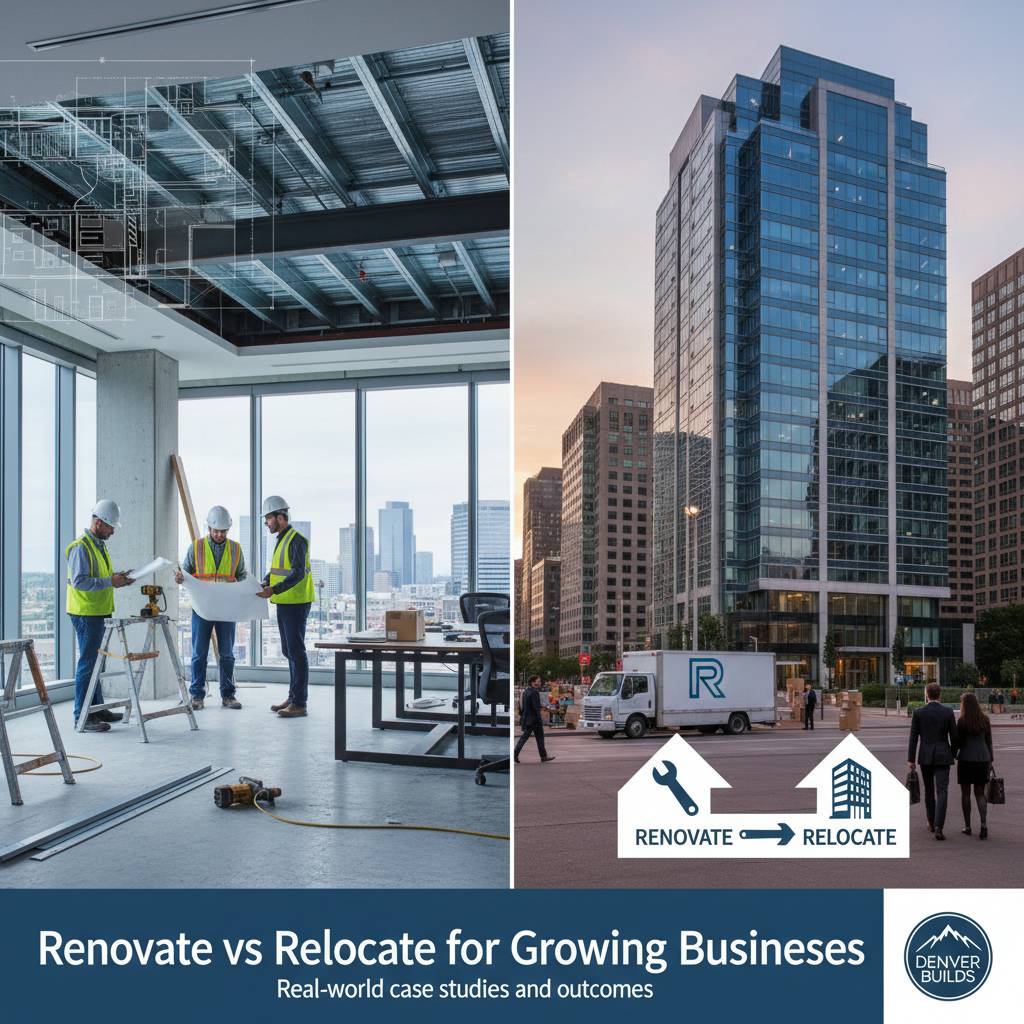
Renovate vs Relocate for Growing Businesses
Growing businesses must weigh renovation versus relocation and Riley Riley Construction helps owners evaluate total cost, downtime, and long-term scalability. We model operational disruptions and financial impacts to find the most efficient growth path. Call Riley Riley Construction to run a comparative analysis for your business needs. Our engaging guidance helps leaders choose the solution that preserves customers and cash flow. Create an SEO-optimized webpage of approximately 15002200 words written in natural, human-sounding language.
Deciding whether to renovate an existing facility or relocate to a new space is one of the most consequential choices a growing business makes. The right move balances immediate financial outlay with long-term productivity, customer retention, and flexibility for future growth. At Riley Riley Construction, we combine financial modeling, operational simulation, and practical experience to help owners and executives see beyond sticker prices and into the real business impact - including downtime, lost revenue, and the hidden costs of change. Call us at 17207828897 to set up a tailored analysis.
Why the renovate vs relocate decision matters for growth
Growth brings opportunity but also complexity. Expanding headcount, higher inventory levels, new production lines, or enhanced customer experiences often require physical changes. Renovation can preserve location advantages - existing customer foot traffic, known commute patterns, and local regulatory relationships - but it can be limited by building constraints and disruption during construction. Relocation may deliver a purpose-built environment and long-term scalability but also introduces relocation costs, potential customer loss, and operational downtime that must be carefully quantified.
When leaders consider renovation vs relocate for growing businesses, they must think beyond capital expenditures to include the timing of expenses, the impact on cash flow, how disruption affects customer confidence, and whether the chosen path supports strategic goals five to ten years out. This decision is rarely pure financial math; it is a combination of numbers, people, and risk management. We help translate those qualitative concerns into quantifiable models so you can compare options on the same terms.
How we model costs and operational disruptions
 Our approach begins with a full-scope cost model that captures both obvious and often-overlooked items. Direct costs include construction, leasehold improvements, moving expenses, and professional fees. Indirect costs cover temporary staffing, training for new systems, incremental utilities, and the cost of customer churn during a move. We combine these with a disruption model that estimates lost revenue from reduced capacity, service delays, or temporary closures and layers in recovery time for staff productivity and customer re-engagement.
Direct financial costs we quantify
We list and size each cost line so decision-makers can see potential ranges. Typical itemized categories include:
- Construction and renovation: permits, contractor fees, materials, and contingency.
- Relocation: moving services, new furniture and equipment, lease incentives, and broker fees.
- Fit-out and technology: HVAC upgrades, network infrastructure, and security systems.
- Operational contingencies: temporary rent for alternate space, drop-in service locations, and inventory staging.
For many projects, construction costs vary widely by market and scope - common ranges might be $75-$200 per square foot for interior renovation, but the specific estimate depends on finishes, mechanical upgrades, and code work. We use local benchmarks and vendor quotes to narrow ranges and apply contingency factors to reflect market volatility.
Operational and customer-impact modeling
Operational disruptions are often the most damaging but least visible cost. To estimate these, we model scenarios that include partial shutdowns, phased operations, and full relocations. For each scenario we estimate reduction in throughput, average transaction value impact, and duration of reduced service. These inputs produce an expected lost-revenue number that feeds into a cash flow model spanning the next several years.
We also model customer retention risk: what percentage of customers might not return after a move or during a lengthy renovation, and how long it would take to rebuild the pipeline. For businesses with high repeat traffic - retail, healthcare practices, or local services - location inertia is powerful. For other businesses, like B2B or e-commerce operations, workforce disruption and logistics may carry more weight. Our models adjust assumptions based on your sector and historical customer behavior.
Comparative analysis: renovate vs relocate
Comparative analysis works best when both options are measured on the same criteria and timeline. We create a side-by-side view that includes upfront capital, soft costs, projected downtime, expected lost revenue, long-term operating expenses, and the strategic value of each choice. The goal is to translate intangible benefits - improved layout, stronger branding, or better labor market access - into projected financial outcomes that can be compared objectively.
Below is a simplified comparison table you can use as a starting point. Our full analysis builds a similar table but integrates cash flow, scenario probability, and sensitivity testing so you understand best- and worst-case outcomes.
| Criteria | Renovate | Relocate |
|---|---|---|
| Upfront capital | Moderate to high depending on structural work | High for fit-out, moving, and lease costs |
| Downtime | Phased or partial downtime possible; may be manageably low | Concentrated downtime during move; potential for longer ramp-up |
| Long-term scalability | Limited by existing footprint and zoning | High if new location is sized and zoned for growth |
| Customer retention risk | Lower if staying in same location | Higher if move disrupts customer patterns |
| Operational complexity | Construction logistics, permits, temporary relocation | Moving planning, systems cutover, staff relocation considerations |
That high-level view is useful, but the final decision depends on the details. For example, a cosmetic renovation that improves customer experience with minimal downtime could be the most cost-effective path. Conversely, if your growth trajectory requires doubling production capacity or access to a new labor market, relocation might be the better long-term investment despite higher short-term cost.
Key factors to weigh when evaluating options
Each business will prioritize different factors, but several consistent themes emerge for leaders deciding between renovation and relocation. Consider immediate cash constraints, access to skilled labor, proximity to customers or suppliers, regulatory or zoning limits, and the expected pace of growth. These elements drive both the tactical and strategic implications of your choice and influence how quickly you see a return on investment.
- Financial runway: Can you sustain capital and operational strain during renovation or relocation?
- Customer behavior: How likely are customers to adapt to a new location or temporary service changes?
- Workforce impact: Will your staff commute patterns be affected, and can key employees be retained?
- Scaling needs: Is flexibility for future expansion a decisive priority?
- Regulatory hurdles: Are there permit or zoning limitations at the current site?
- Real estate market: Are better lease terms or purchase opportunities available elsewhere?
Using a checklist approach helps you apply consistent weight to each factor. We recommend assigning a numeric score to each element and then running sensitivity tests to see how the preferred option changes under different assumptions. That disciplined process reduces gut-driven bias and surfaces tradeoffs in a way your board or lender can understand.
Real-world case studies and outcomes
 Case study: A regional retail chain faced chronic overcrowding at a high-traffic store. Renovation would have improved layout but could not increase square footage. We modeled both options and found that relocation to a larger nearby center produced 35% higher five-year incremental revenue, even after accounting for moving and tenant improvement costs. The model included a targeted customer communications plan to minimize churn and a temporary mobile pop-up to retain sales during the transition.
Case study: A professional services firm needed modern collaboration spaces to attract younger talent but had a loyal local client base. Renovation allowed them to preserve their address and client relationships while updating amenities. Phased construction reduced downtime to two weekends for major work, and a modest investment in technology and acoustics produced measurable productivity gains within three months. The quantitative model showed renovation paid back in 18 months through improved utilization and reduced staff turnover.
Case study: A light-manufacturing company had production bottlenecks and inadequate ceiling heights for new equipment. Renovation costs to achieve the necessary volume were nearly equal to relocation costs, but zoning restrictions made renovation timeline uncertain. We recommended relocation to a suitable industrial park. Although initial costs were higher, the long-term productivity gains and faster permit process produced a stronger net present value across a 10-year horizon.
Step-by-step evaluation process we use
Our process is practical, transparent, and collaborative. We begin with a discovery phase to understand your growth strategy, customer mix, workforce needs, and financial constraints. Then we gather site-level data and vendor estimates to create a realistic budget. From there we run operational disruption scenarios and generate cash flow projections that include probability-weighted outcomes. Stakeholders receive a dashboard that highlights break-even timelines, sensitivity to downtime, and recommended mitigations.
- Discovery and objectives alignment: clarify business goals and growth metrics.
- Data collection: vendor quotes, lease terms, historical revenue and traffic patterns.
- Scenario modeling: phased renovation, full renovation with temporary closure, and relocation options.
- Sensitivity analysis: test assumptions on downtime, customer churn, and unexpected costs.
- Decision support: present a recommended path with contingency plans and communication strategies.
At every step we emphasize pragmatic mitigation measures: schedule construction during off-peak hours, use temporary fulfillment centers to maintain service, stagger staff shifts, and invest in honest customer communication to preserve trust. These actions often reduce the projected revenue hit by a meaningful margin and sometimes change which option is optimal.
Practical tips to reduce risk and downtime
Reducing downtime is as much about planning as it is about spending. Small investments in logistics and customer communication can significantly lower revenue losses. For instance, cross-training staff ahead of a move, pre-configuring IT systems in the new space, and running parallel operations for a short period can smooth the transition. We also recommend negotiating phased buildouts into renovation scopes so parts of the facility remain operational while others are upgraded.
- Run pilot operations or temporary pop-ups to keep revenue flowing during construction.
- Negotiate flexible lease clauses and tenant improvement schedules.
- Secure reliable contractors with experience in live-site work to limit surprises.
- Develop a customer retention campaign timed to the move or renovation milestones.
Another often overlooked area is equipment and IT cutover. Physical moves are complex, but data and systems disruption can be more harmful and harder to quantify. Plan parallel testing and a rollback option to avoid prolonged outages. A small investment in redundancy or temporary cloud-based services can pay for itself by avoiding days of lost productivity.
Conclusion: framing the decision and next steps
The renovate vs relocate for growing businesses choice is not a binary financial decision; it's a strategic crossroads. Renovation can protect customer relationships and minimize immediate disruption, while relocation can position you for sustained growth if capacity, zoning, or workforce needs demand it. The best firms balance financial rigor with an honest appraisal of operational realities and customer behavior. Riley Riley Construction helps translate those realities into actionable, side-by-side comparisons so you can choose the option that preserves customers and cash flow.

If you're ready to quantify your options and run a comparative analysis tailored to your business, call us. We will deliver an easy-to-understand dashboard, scenario narratives, and a recommended path with mitigation strategies. Contact Riley Riley Construction at 17207828897 for a consultation.
Our team looks forward to helping you make the choice that supports growth without unnecessary disruption. Whether you renovate, relocate, or pursue a hybrid approach, we provide the modeling, operational planning, and execution guidance to protect customers, maintain cash flow, and position your business for the next stage. Reach out to Riley Riley Construction at 17207828897 to get started.